
Guide7 min read
AI for accountants: practical uses that keep client data confidential
What AI can do in an accounting firm, what it should not touch, and what the rules in Germany and the UK say about client data in AI tools.
By the LionBox team
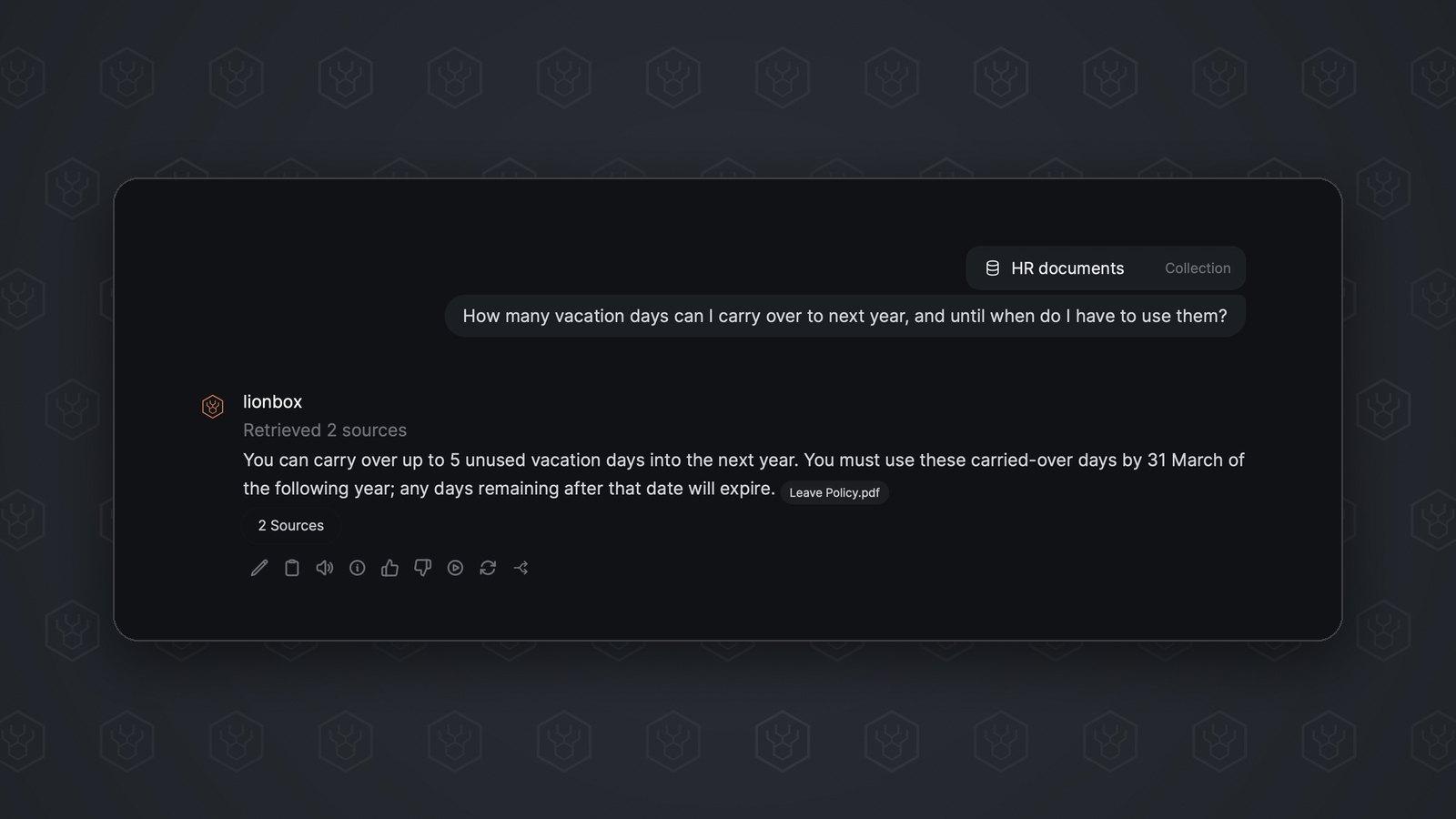
AI for accountants is useful for a plain reason: much of the work is text. Invoices to read, letters from the tax office to summarise, client emails to answer, guidance to look up. A language model is good at exactly that kind of task. It is less good at the part clients pay for, which is being right.
This guide is for practices with 5 to 30 people. It covers what AI can take off your desk, what it should not touch, what the rules in Germany and the United Kingdom say about client data, and how to choose where the AI runs.
What AI can do in an accounting firm
The best starting points have two things in common: they take time every week, and a person can check the result quickly against the original.
| Task | What AI does | What a person checks |
|---|---|---|
| Invoices and scanned documents | Reads the scan and lists number, date, supplier and line items | Totals, dates and identifiers against the original |
| Questions about firm documents | Finds the passage and answers with the source | That the source says it and is still current |
| Long letters, contracts and notices | Summarises and lists deadlines and open points | Every deadline, in the document itself |
| Client emails | Drafts a reply in the right tone or language | Facts, figures and anything that reads like advice |
| Meetings | Turns notes or a recording into action items | Names, dates and permission to record |
| Spreadsheets | Explains differences and suggests what to look at | Every number, recalculated with a proper tool |
These are also the tasks an internal AI assistant handles for other office teams. What differs in a practice is the duty attached to the documents.
What AI should not do
- Calculate. A language model writes text that looks like the right number. Sometimes it is slightly wrong, and it does not look wrong. Keep sums in your accounting software or a spreadsheet.
- Decide on tax questions. Models can name rules, rulings and court cases that do not exist. UK guidance on AI in tax points to a tribunal case in which invented decisions were put forward (Harber v HMRC). Look up every reference.
- Send or file anything on its own. Professional responsibility stays with you, whatever produced the first draft.
The UK tax bodies put it in a useful way: treat the output as if a less experienced junior colleague had prepared it, and review it with appropriate scepticism.
What the rules say about client data
The details differ by country. The direction is the same: the duty of confidentiality does not stop when the recipient is software.
Germany. Tax advisers must keep confidential everything they learn in their work (§ 57 StBerG), and unauthorised disclosure can be a criminal offence (§ 203 StGB). Unlike the GDPR, this also protects the data of companies. Using a service provider is allowed under § 62a StBerG, with conditions:
- Access only as far as the service requires, and a carefully selected provider.
- A contract in text form that binds the provider to confidentiality, explains the criminal consequences and settles who else may be involved.
- For services rendered abroad, in principle only where secrets enjoy comparable protection.
- The client’s consent if the service directly serves a single engagement. The Federal Chamber of Tax Advisers says it is not beyond doubt when this covers AI, and advises obtaining consent before entering sensitive client data.
In its FAQ on AI, the chamber says confidential client data should never be entered unprotected into public AI services, and that private AI accounts must not be used for work. Where confidentiality is not secured, data has to be anonymised or pseudonymised first.
United Kingdom. The joint guidance of the tax bodies says entering client data into publicly available AI tools is likely to breach confidentiality unless the client has consented. Data put into such tools should be anonymised so the client cannot be identified. ICAEW expects firms to have policies on generative AI and to train their staff.
Where client data goes: three setups
Public AI tool, personal account
- Employee’s browser
- Internet
- Provider, under consumer terms
Not a place for client data. Fine for general texts such as a newsletter, with nothing that points to a client.
Service with a contract
- Browser or practice software
- Internet
- Provider, bound to confidentiality
Workable if the contract meets your professional rules. Check location, subcontractors, training and deletion, and whether client consent is needed.
AI on your own network
- Browser in the practice
- Office network
- AI hardware in the practice
No outside AI provider processes the documents. Access rights, data protection and your own checks remain your job.
No setup is right for everyone. The German chamber points out advantages of AI built into practice software: it is integrated, and questions of confidentiality are usually settled. It also notes that a system installed locally under the firm’s control may offer more data protection, while a cloud service takes care of updates and maintenance. Many firms will combine the two.
A safe workflow, from document to result
Choose one task
Pick something frequent and easy to check, such as extracting data from supplier invoices. Not tax research, not advice.
Decide where it runs
Match the setup to the data. If client documents go in, a public tool is out.
Test with harmless documents
Use your own or invented invoices first. Note what comes back wrong: totals, dates, similar names.
Name the person who checks
Every result gets compared with the original before it is booked, sent or filed.
Write it down
Tool, task, permitted data and check, on one page. Train the people who use it, then add the next task.
Where LionBox fits, and where it does not
LionBox is a compact AI server for teams of 1 to 30 that stands in your office. People use it in the browser to ask questions about documents, read scans, draft and translate. AI processing runs on the box, so prompts and documents do not need to go to an outside AI service. Internet search is off by default. Administrators manage accounts and permissions without reading private conversations, and knowledge spaces limit who can ask about which documents. Our page on secure AI for business shows what stays on the box and what can leave it.
The limits, said plainly:
- LionBox is an assistant. It does not replace your accounting or tax software, and it is not a source of tax law.
- It runs a compact model. On very complex questions, the largest cloud models do better.
- If someone outside gets access to client data, for instance during support or a repair, the rules above apply again. For hardware service, we agree how the data drive can stay with you. The warranty page explains the process.
- Your professional and data protection duties still depend on how you set it up and use it.
Your AI policy, on one page
- Which tools are approved, and that private accounts are not.
- Which client data may go into which tool, and what must be anonymised first.
- Who checks results, and that nothing leaves the firm unchecked.
- When clients are asked or told, for example in the engagement terms.
- What to do if client data ends up in the wrong tool, and who to tell.
If you suspect that public tools are already in use, start with our article on shadow AI at work. The 7 questions to ask an AI provider help with the contract check.
Short answers
Can accountants use AI with client data?
Yes, under conditions: a setup that protects confidentiality, a suitable contract if a provider is involved, client consent where your rules require it, and a person who checks the result. Public AI tools are not suitable for identifiable client data without consent.
Will AI replace accountants?
It takes over parts of the reading and drafting. Judgement, responsibility and the final check stay with qualified people.
Do we have to tell clients that we use AI?
It depends on your rules. The German chamber currently sees no express professional duty to do so, although the point is still debated. Data protection information is required when clients’ personal data goes to an AI service, and the chamber recommends openness.
Is a local AI enough to meet professional secrecy?
Not on its own. It removes the outside AI provider from the path of your documents. Access rights, support access, checks and data protection remain your responsibility.
Sources
- § 62a StBerG, § 57 StBerG and § 203 StGB (in German)
- Federal Chamber of Tax Advisers: FAQ on AI (PDF, in German)
- UK tax bodies: PCRT guidance on AI tools
- ICAEW: AI and client data
This is general information, not legal or tax advice. Rules change and differ by country and profession. Check with your professional body.